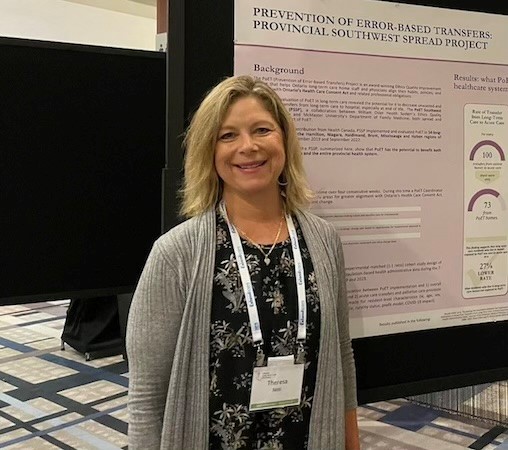
When you speak with Theresa Nitti, RPN, one thing becomes clear almost immediately: her passion for quality, ethics, and resident-centred care runs deep. Today, Theresa is a Provincial Program Coordinator with the PoET (Prevention of Error-Based Transfers) at William Osler Health System, a role that has positioned her at the intersection of ethics, clinical practice, and health-system innovation. But the path that brought her here is as grounded, compassionate, and community focused as the work she champions today.
A Calling That Found Its Moment
Theresa’s journey into nursing was not straightforward. As a teenager, she spent weekends cleaning her family doctor’s office but then secretly spent her time reading the medical textbooks on the shelves. “I should have known then” she laughs. “But I didn’t believe I could be a nurse.”
She built a career first as an esthetician, then shifted into health care as a personal support worker, supporting residents in a long-term care day program and in supportive housing. Those roles revealed a deeper pull toward meaningful, hands-on care. With encouragement from her supervisor, she returned to school to become an RPN. “It felt like a calling,” she says. “Once I started, everything just fell into place.”
Her work took her across a wide range of settings including family practice, supportive housing, long-term care, adult day programs, medical units, and finally palliative care. Along the way, she was nominated for the Toronto Star Nightingale Award, an honour she still holds close. “To know I made a difference in even one person’s life… that’s everything.”
Seeing the System Through Many Lenses
Theresa’s diverse practice settings gave her a rare, full-system view of how residents and patients move through the care continuum. She saw the beauty of interdisciplinary teamwork and the consequences when communication, consent, or coordination break down. Those experiences shaped her commitment to quality improvement.
“I could see the whole journey,” she explains. “Where transitions worked well, where errors could happen, and where residents’ wishes weren’t always guiding decision making. That perspective really shaped how I approach my work today.”
From Bedside to Ethics & Research
In 2019, Theresa joined the Ethics Team at William Osler Health System as a Spread Leader for the PoET Southwest Spread Project (PSSP) which was a joint venture between William Osler Health System’s Ethics Quality Improvement Lab and McMaster University’s Department of Family Medicine. It turned out to be the perfect fit. That same year, the PoET Southwest Spread Project received a major contribution from Health Canada to evaluate how aligning long-term care practices with Ontario’s Health Care Consent Act could reduce error-based transfers within the healthcare system.
Theresa became one of the Spread Leaders responsible for implementing the PoET program in 54 long-term care homes, observing real-world practices, identifying gaps, supporting staff, and coaching teams through meaningful improvements.
When the pandemic hit, the work could have halted. Instead, the PoET team reimagined the entire program virtually, creating an innovative solution that later became the foundation for PoET’s province-wide reach.
“That was one of the biggest challenges,” Theresa reflects. “But it pushed us to create something sustainable, accessible, and able to support homes anywhere—even in full outbreak.”
Evidence That Matters
The results of the PoET evaluation, conducted by McMaster University, were striking:
- Long-term care residents in homes exposed to PoET are sent to acute care 27% less often than residents in homes not exposed to PoET.
- At end of life, residents in PoET-exposed long-term care homes are sent to acute care 45% less often than those in non-PoET homes.
- Residents in PoET-exposed long-term care homes receive palliative care at a 147% higher rate than residents in homes not exposed to PoET.
These outcomes are now published in the Journal of the American Medical Directors Association and formed part of the foundation for PoET winning the 2025 Ontario Health System Quality and Innovation Award for Improved Value and Sustainability. They also played a central role in Theresa receiving the 2025.
WeRPN Award of Excellence in Research
“Research, to me, is really about voice,” she says. “It’s how we tell the story of what’s happening and how we make things better for residents. I never thought I’d be involved in research, but once I discovered quality improvement, everything clicked.”
A Global Stage
Theresa’s research journey has taken her far—literally. During the pandemic, her team responded to a World Health Organization call for proposals to examine ethical issues in long-term care across high-, middle-, and low-income countries. Their findings were accepted for oral presentation at the World Congress for Public Health in Rome.
Standing in a room filled with global experts was unforgettable. “It was powerful,” she says. “To hear what others were doing around the world and to share our work was incredibly meaningful.”
A Proud RPN, Shaping the Future
Theresa is passionate about the future of practical nursing, especially in research, evidence-informed practice, and ethical long-term care. She challenges RPNs and especially early-career nurses to dream bigger.
“Don’t limit yourself. Your voice matters. Research isn’t just for academics; it’s for anyone who wants to improve care. I found my way by saying yes to opportunities, even when I wasn’t sure I was ready.”
Her commitment to continual learning is evident. Theresa is now completing her Master of Health Science in Bioethics at the University of Toronto’s Dalla Lana School of Public Health which is the very institution that recently recognized her team’s work.
Theresa’s Advice for RPNs Interested in Research:
- Be open to learning because opportunities come in unexpected forms.
- Use your voice as frontline insights are essential to good research.
- Know your value and lived expertise.
- Stay curious because quality improvement begins with a single question.
Looking Ahead
Theresa envisions a future where RPNs are increasingly recognized as leaders, innovators, and system-level contributors.
“We bring a unique, grounded understanding of care. When RPNs lean into quality and ethics—and when we’re empowered to speak up—we can transform the system. I’m proud to be an RPN, and proud of what we can achieve.”